Cocoon — Australian Market Entry Strategy
Cocoon is a Vietnamese vegan skincare brand built on one simple idea: that beauty should be honest, affordable, and rooted in the land it comes from. Every product tells an ingredient story — turmeric from the Hung Yen province, coconut oil from Ben Tre province, winter melon sourced from Vietnamese farms. Cocoon is Vegan Society certified, cruelty-free, and GMP-compliant, and it already has a foothold in the Australian market through its official stockist, embescorner.
What drew me to this brand was the gap between what Cocoon is — genuinely ethical, affordable, story-rich — and how visible it was to Australian consumers. That gap felt like a real strategic problem worth solving.
Challenge
- Low brand recognition: Almost no Australian customer awareness despite existing Australian stockist activity, only popular among the Vietnamese in AU.
- Asian skincare scepticism: Many Australian consumers are unfamiliar with or uncertain about Asian skincare brands and formulations.
- Strong local competition: Established Australian vegan brands (Go-To Skincare, Aesop, Frank Body) dominate the ethical beauty shelf.
- Restricted access retailers: No presence in any major Australian physical retailer, Chemist Warehouse, Priceline, or Mecca.
My Approach
Before making any recommendations, I worked through a structured research process to understand both the brand and the market it was entering:
- I mapped Cocoon’s core brand values against what Australian vegan beauty consumers actually prioritise — finding that Cocoon already delivered on the key drivers (certifications, affordability, ingredient transparency) but hadn’t communicated them in Australian consumer language.
- I analysed the competitive landscape: Aesop (premium, design-led), Go-To Skincare (simplicity, Gen Z), Frank Body (mass-market, accessible).
- I identified the target audience as Gen Z consumers who are vegan or vegan-curious, actively seeking cruelty-free alternatives, and drawn to brands with cultural authenticity.
- I researched the existing Australian distribution footprint and found embescorner — Cocoon’s official AU stockist — as the logical retail anchor for any strategy, rather than starting from scratch.
The Strategy
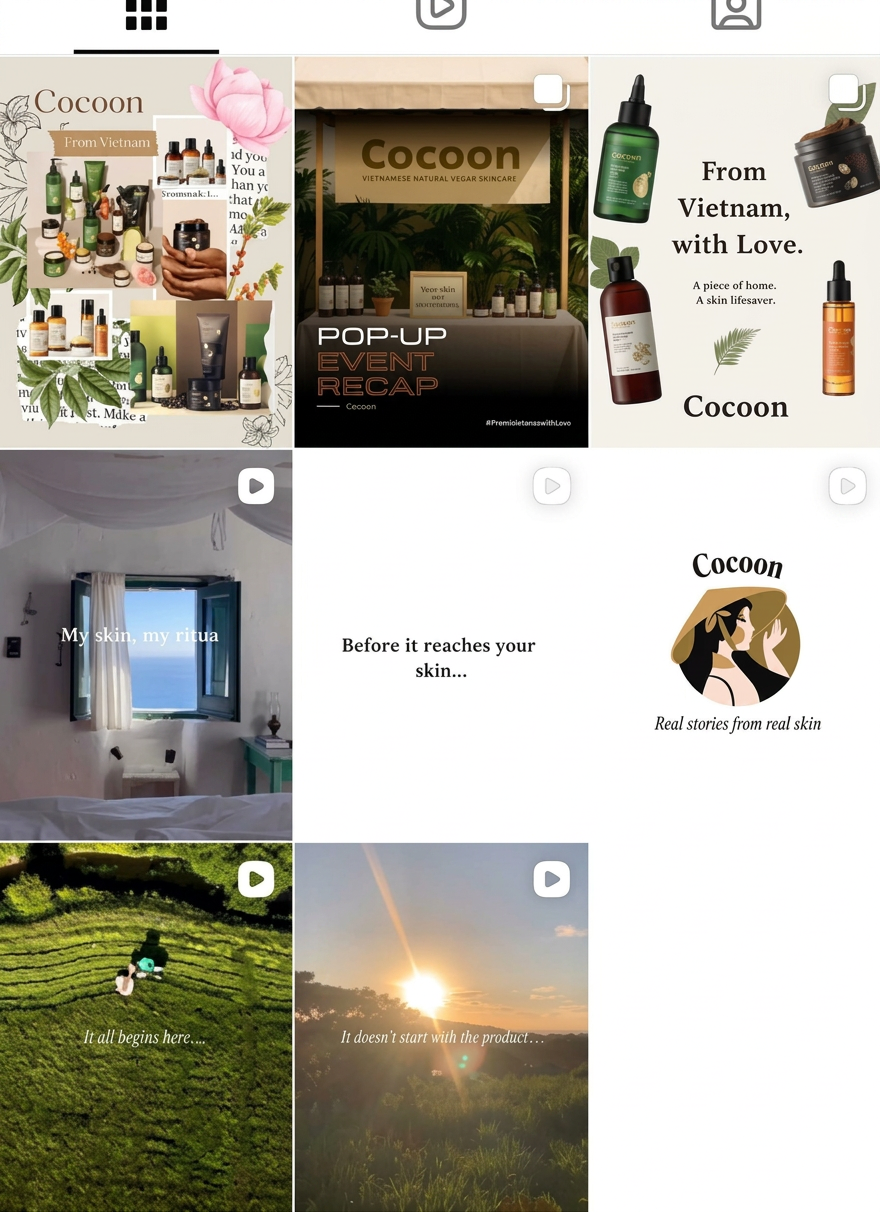
The positioning I recommended was “Beauty From The Tropics”. This means Cocoon – Made in Vietnam. Loved by nature. Approved by your skin. It’s “tropics” not “tropical” like Hawai or Bali because it’s tropical beauty rooted in Vietnam – strange but close in Asia. I want to build a storytelling about Vietnamese agricultural products.
- Ingredient storytelling: Lead with Vietnam — Vietnamese tropical ingredients, the farmers, the land. Make the origin the differentiator, not a footnote.
- Trust through certification: Front Vegan Society, cruelty-free, and GMP badges prominently. Australian consumers respond to third-party proof over brand claims.
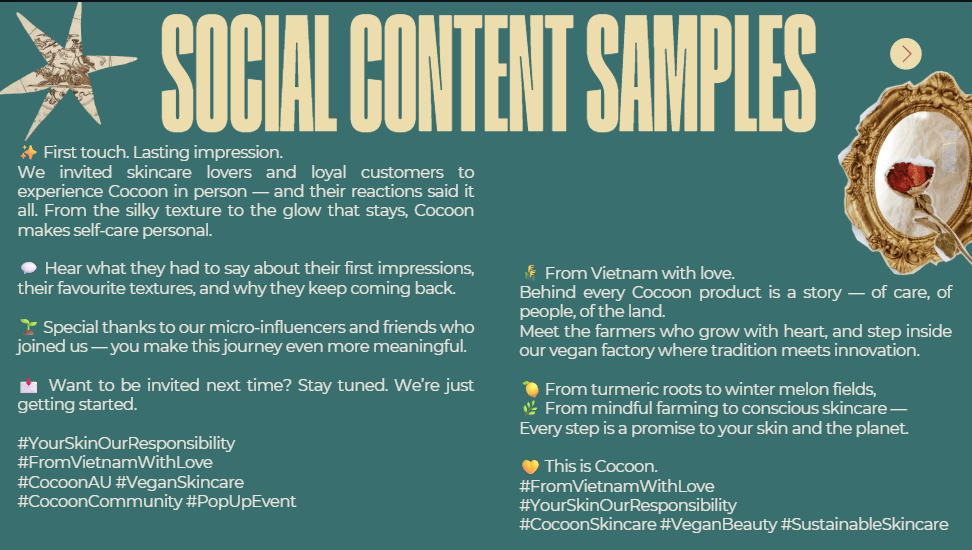
- Micro-influencer activation: Partner with Australian vegan and skincare micro-influencers who have high trust with niche ethical beauty audiences — not mass reach.
- Retail with a pop-up presence: Leverage embescorner as the AU retail anchor, then build brand trial through pop-up booths at sustainability-aligned markets and festivals.
Key Insight
Australian vegan beauty consumers don’t just want ethical products — they want to feel like they discovered something real. Cocoon’s Vietnamese origin isn’t a liability to manage; it’s the most compelling thing about the brand. The strategy’s entire job was to make that story visible, credible, and easy to trust at first encounter.
What I learned
- Positioning is about communicating a brand’s existing truth clearly to the right audience.
- Cocoon did not need to change for Australia — it just kept its origin and built more strategic communication.
- I learned how distribution strongly influences overall marketing strategy.
- Discovering embescorner shifted the strategy from market entry to market expansion.
- Future improvements would include a 6-month activation budget.